Landing post for people curious about the Fediverse
Introduction#
Hello! If you read this you have most likely been harassed by me about the Fediverse. Because I can’t shut up about it, and because I find myself sending around the same links to everyone all the time, I thought it would be good to have a “landing post” to refer people to.
First of all, thanks for taking the time to read this. My enthusiasm about the Fediverse is rooted in a conviction that our digital world can and must be better, but it does require all of us to pause and take some time to explore.
Side note: to connect with other newcomers, feel free to submit your name and Fediverse account (once you have it) to this form, which does an hourly update to this overview, so we can help, support and follow each other. (Or simply use your Fediverse account to reply to this post. See all the way below).
Ok, instead of me yapping on about what the Fediverse is, and why it matters, I suggest you start by watching these two videos, one by TILvids and one by Italian film maker Elena Rossini.
What is the Fediverse?#
Introducing the Fediverse: a New Era of Social Media:#
Mastodon in 180 seconds:#
Getting started right away#
If you didn’t come here to read, but to DO STUFF, great!
Selecting an instance#
As you have learned from the two video’s, the Fediverse consists of many platforms, of which Mastodon is the biggest.
My suggestion would be to first check out Mastodon, and then (if you’re up for it), explore some of the other platforms.
As you have also learned from the two video’s, you now know that there are many Mastodon instances (or “servers”). This is fundamental to the politics of the Fediverse (see below).
N.B.! If you, like me, study or work in higher education in the Netherlands, you’re lucky, because Surf.nl, the organization that takes care of our digital infrastructure, runs a Mastodon server for us! Just go to https://social.edu.nl and log in with your regular institutional credentials!)
If you do not study or work in higher education in the Netherlands, or if you prefer to keep your Fediverse experiment separated from your life in education, you will have to find your own instance.
In that case, this is a great tool to help you choose: Fedi.Garden.
Picking an instance is a bit like finding a community of likeminded people. It determines …
- … what people and posts will be most easily visible in the beginning, and
- … what kind of moderation rules will be applied.
Don’t worry too much about it though because …
- … you can interact with people on other instances.
- … you can always later on decide to “migrate” your account to another instance, without losing your follows and followers.
Expectation management: some instances require you to write a little bit about yourself, so that they know what they are getting into, and the “instance admins” might take some time to get back to you.
First steps in the Fediverse#
If you’re wating for the instance admin to approve your request for an account, skip this part and jump to the section “It is political”.
If you do have an active account: congratulations! And thank you for being part of the Fediverse! Which means that you are part of the solution to (what I think is) one of the biggest problems of our time!
Ok, I have seen that people feel a bit lost at this point.
You don’t recognize anyone, you don’t know what to post. This world doesn’t look at all like Instagram or TikTok, which serve people unlimited content of the kind that they (have grown to) like.
One simple, wholesome thing to do now, could be a simple introduction of who you are, and what you’re into.
I feel that the Fediverse, with it’s ideology of decentralization, is also an invitation for more people to be more active in producing content, rather than to just be consuming it. To contribute to your community by sharing what you find important, beautiful or funny, rather than to have corporate algorithms serve you what they think you find important, beautiful or funny.
If you want, do tag me to your post: @mishavelthuis@social.edu.nl. I would be super happy to connect with you! (You can either go to this link and follow me, or go to the search bar and search @mishavelthuis@social.edu.nl).
Still, of course, you don’t always have something to share, and sometimes you just want to read what other people are up to.
Finding people to follow can be a bit daunting on the Fediverse. Whereas corporate platforms immediately suggest “great accounts” on the basis of whoever they think you are, on the Fediverse you have to curate your own world, by exploring timelines, profiles and hashtags etc. This is a great starting point to help you get going.
(And remember that form + overview mentioned at the top of this post! You can reach out to other people who made it to this landing page!)
Mastodon also allows members to build tiny “starter packs” to help find interesting people. I have one with people posting in English (link) and one with people mostly posting in Dutch (link).
If you feel adventurous, you could now check out this blog post where I gave some more tips on building a network on the Fediverse.
A day in the Fediverse#
Ok, before I lose myself in some more abstract political points (below), let me share with you how the Fediverse is part of my day.
N.B. I don’t mean to overwhelm you. I just want to show how the Fediverse is a larger ecosystem, and how this ecosystem works for me. If knowing about Mastodon is enough for you now, feel free to skip to the part “It is political” below.
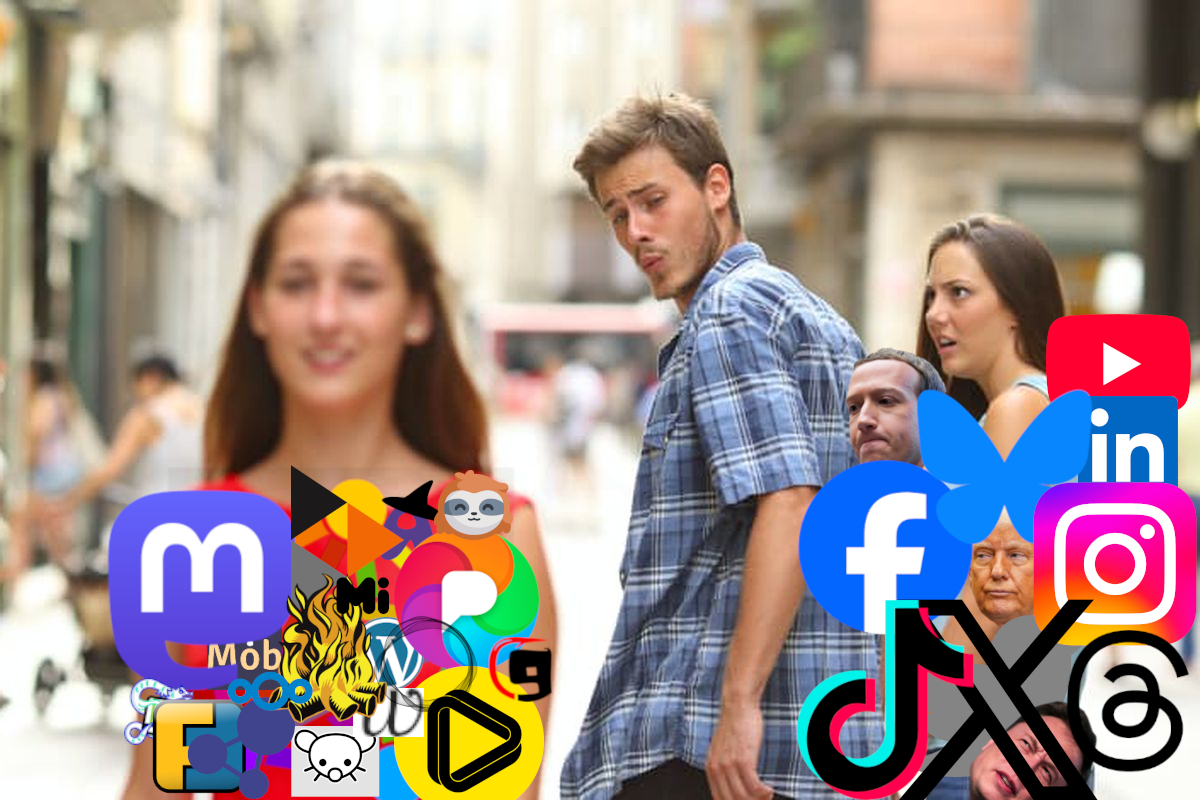
Mastodon#
- On my Android phone I use the app Moshidon. There are many apps that allow you to connect with your Mastodon account, like the default one “Mastodon” or “Tusky”. I like Moshidon because it allows me easily keep track of different lists (see this post to learn more about lists).
- In my browser on my laptop I have one tab “pinned” with my Mastodon account. I have enabled the “advanced web interface” in settings, so that I can (again) easily keep track of the different lists I have.
Lemmy#
- I also have an account on “Lemmy”. Lemmy is a Fediverse alternative to Reddit. The instance I picked is https://lemmy.dbzer0.com but you can of course pick your own, e.g. using this list.
- I use the app Jerboa, and I generally just put the settings at “show me the most liked posts of the last six hours”. This is where I get my memes. It’s where I do some mindless scrolling when I just want to be entertained.
Loops#
- When I have a small video that I want to share I tend to post it on Loops, which is platform that is more focused on short video content than Mastodon. The instance that I am on is https://loops.video, and you can find my account here.
- There is an app called Loops, which works well for me!
- I sometimes open this app to check what people are up to. It’s still a weird corner of the internet, inhabited by strange and suprising people, but I (mostly) love it. This is what the early internet must have been like.
- Cool detail: because all Fediverse platforms connect, you can follow a Loops account from Mastodon. So if you find someone posts cool stuff on Loops, you can search the account on Mastodon and give it a follow. You will now be able to follow that person’s Loop content from Mastodon! (This applies to all platforms in this list: Lemmy, Bookwyrm, Pixelfed, PeerTube).
Bookwyrm#
- For those of you who like Goodreads: there is a great Fediverse alternative. I am on an instance called https://bookrastinating.com/, but you can of course pick your own server here. You can find my account here.
Pixelfed#
- Sometimes, just sometimes, I take a picture and I think “ha… this could be an actual photograph”, after which I post it on Pixelfed, which is a more photography oriented platform on the Fediverse. I am on an instance called https://gram.social, but you can pick your own. You can find my (tiny) account here.
- I am currently using the (Android) app Pixelix, which works great for me!
Bonfire#
- Bonfire is one of the most recent additions to the Fediverse. It is specifically meant for communities to build a more sheltered environment to connect. A little bit like … a bonfire. We at OpenTech(AUC) run our own Bonfire server: https://bonfire.opentech-auc.org. If you are a student or staff member at AUC or at the UvA, you can use the Keycloak button to register for an account (which you can also use to log in to PeerTube (see below), Nextcloud, Cryptpad or our git server).
PeerTube#
- PeerTube is like YouTube, but decentralized and open source. We at OpenTech(AUC) run our own PeerTube server: https://tube.opentech-auc.org. If you are a student or staff member at AUC or at the UvA, you can use the Keycloak button to register for an account (which you can also use to log in to Bonfire, Nextcloud, Cryptpad or our git server).
It is political#
Quit the digital world? Or create a better one?#
To me all of this is deeply political, for the simple fact that our world is becoming increasingly digital.
I respect my friends and colleagues who try to fight that. Who try to touch grass and buy a dumb phone without internet access. There is a lot to be gained there. Nothing beats meeting up in person and organizing on the street.
Still, no matter how hard you try, I believe that the future will inevitably be at least partly digital. And not only do I therefore believe that we have a responsibility to build a better digital world, I also think that it is possible to do so, in a way that will even be enriching.
Our current digital world is dominated by the worst of us: we have let the worst people use the worst tricks to play on our worst instincts and reflexes, causing us to be our worst possible selves. And these people accumulated unfathomable amounts of wealth that they are now using to destroy our democracies (see Naomi Klein’s “End Times Fascism”).
But just like we are currently in a downward spiral, with algorithms pulling people into the far right abyss, we can also build another world that can - in my personal experience - be a spiral upwards: of joy, mutual learning and gratitude.
This is not a story of fear and anger, this is a story of repair.
A protocol, not a platform#
Many of us have seen platforms come and go (Facebook, Twitter, Instagram, TikTok, Snapchat), and each time you hear that YOU REALLY HAVE TO JOIN BECAUSE IT’S THE NEXT BIG THING, DON’T BE LIKE THE SUCKERS OUT THERE! JOIN THE COOL KIDS!
Many of us have had enough of this. Not just because you grow tired of the hype cycle, but also because the platforms grow worse over time. I really recommend reading the first chapter “The natural history” of the book “Enshittification” by Cory Doctorow to understand why this is by design rather than by accident.1
But as the video “Mastodon in 180 seconds” already pointed out, the Fediverse is different: it is not a platform, it is a protocol.
In a nutshell, this simply means that it is a certain agreement on what our messages should look like for us to be able to easily send and receive them.
Anyone can set up anything, and be part of the Fediverse, as long as they stick to that simply agreement.
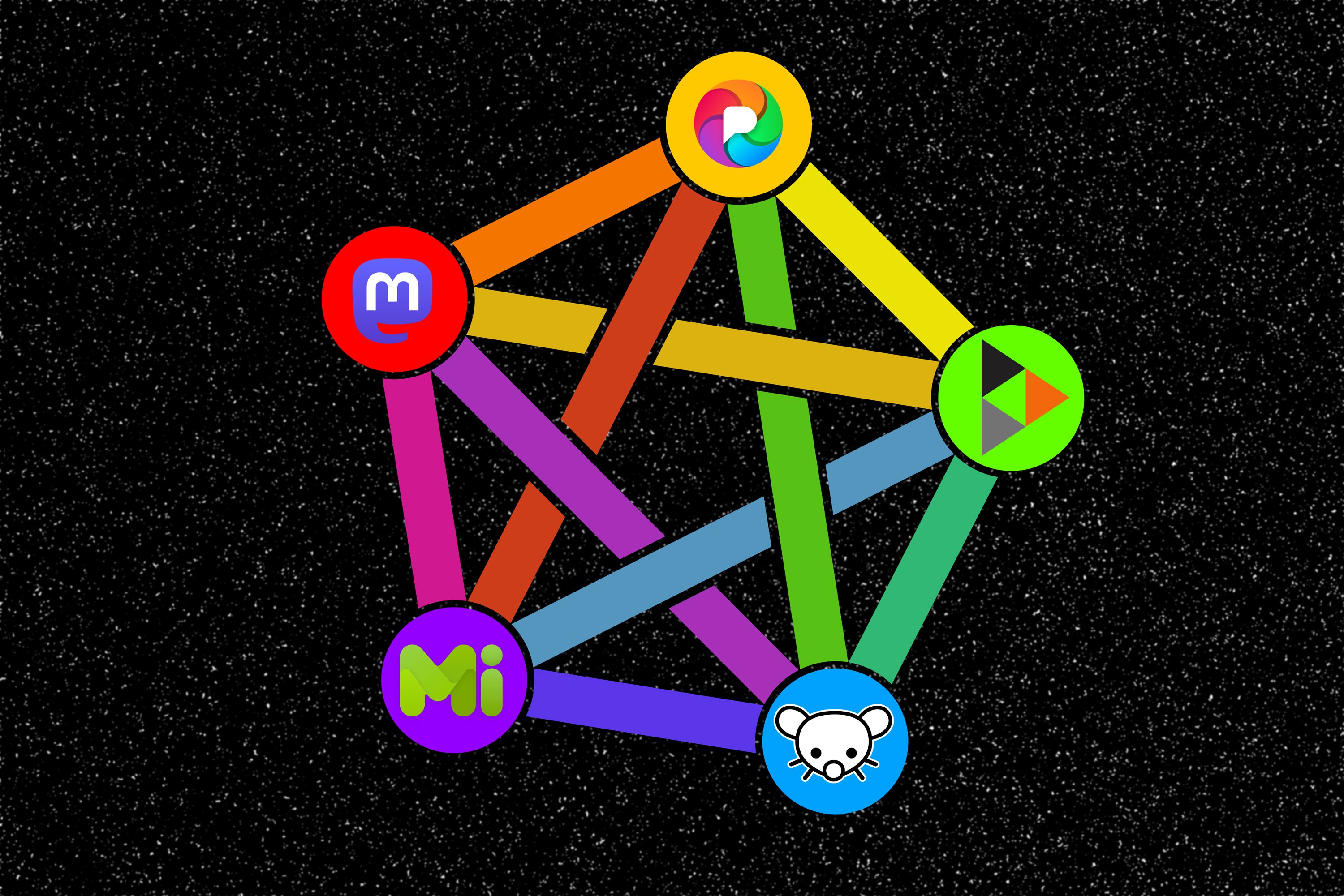
What happened is that once this protocol was agreed upon, communities started building software around it. And once they were done they released their code to the wider public.
Take Mastodon: anyone can download the software, install it on a computer, and voilá: you have a Mastodon instance. The same goes for Pixelfed, and all the other Fediverse platforms.
Community freedom#
This brings me to the second-last point, which hopefully brings it all together.
Our current digital world is not built by us, and not built for us. It serves the interests of people whose interests you really do not want to serve.
We depend on the people who control the single node in the centralized network - people like Elon Musk - to determine, for us, what content is acceptable and what is not. What content should be promoted and what content should be suppressed.
The Fediverse, on the other hand, is built by communities, for communities, and these communities have decided to put the power in the hands of …. the communities.
Every Mastodon instance is a sovereign node in a decentralized network, which means that it is up to the communities to decide how to run and moderate it. And if anyone in one community doesn’t like the way that community is running/moderating the instance, they can take their account and move it to another instance, without losing any follows/followers.
In other words: communities decide for themselves how they want to live, while at the same time, individuals are free to find their own community.
This is a system that has freedom baked into its very architecture.
Plus one#
One final point: for many people it is simply not an option to leave corporate social media. For example because they are an artist, and they need their Instagram audience to make a living.
People are therefore increasingly advocating for a “plus one” approach: it is understandable that people cannot immediately leave the social media platforms they are invested in, but they can slowly, steadily, start cross-posting content to a parallel world of Fediverse alternatives.
So rather than just posting on Instagram, you can post on Instagram plus Mastodon, or Instagram plus Pixelfed.
Or rather than just posting on YouTube, you can post on YouTube plus PeerTube.
That way you can continue your current “business as usual” while you at the same time contribute to our collective escape.
The joy#
For me, the Fediverse has made my digital life fun again. I am meeting great people, I have enriching conversations, I feel encouraged to share my ideas, I feel safe, and I feel inspired by the people around me, who are all contributing to something beautiful.
And because there is no army of “interface psychologists” making me addicted to the “infinite scroll”, at the end of the day, I still have time to go out meet friends and touch grass.
If that sounds appealing: nobody is stopping you from joining!
Extra reading#
Some other things that I have written about the Fediverse:
- How the Fediverse can help us escape the revival of feudal exploitation: link.
- How our current digital challenges are an important test of our collective ability to save ourselves: part 1 and part 2.
- Why universities have a special responsibility to take students along in exploring the Fediverse: link and link.
- Me enjoying the Fediverse: link.
- Tips for building your Fediverse network: link.
- In the beginning of 2026 I recorded three small online talks on Big Tech and the Fediverse: link.
-
Cory Doctorow sells ebooks that are not tied to any Big Tech platform like Amazon. When you buy the ebook it will be a file on your computer that you own forever, not a link to a file on a corporate server, which locks you into some shitty subscription or can be taken down at any moment. ↩︎
Comments
You can use your Fediverse (i.e. Mastodon, among many others) account to reply to this post/account.