Technofeudalism: living on the wrong side of a new mode of production
From capitalism to technofeudalism#
A few months ago I wrote a little piece about capitalism. The premise was that, to see the distinctiveness of our current capitalist world, it helps to go back in time to see what it looked like before. A bit like traveling helps to see the distinctiveness of your hometown.
What distinguishes capitalism from feudalism, I wrote, is the separation of labour from the means of production, the ensuing emergence of money relations and markets, and the resulting systematic imperative for capitalists to reduce costs to retain market share.
Today I want to complicate things a bit by exploring the argument that actually, in certain parts of our every day life, we appear to be moving back to a world of feudal relations. This is the idea of “technofeudalism”.
Again, I’m drawing freely on the work of others, in an attempt to find my own words for a changing world.
Are we digital serfs?#
It might sound a bit insane at first: how can this medieval world of mud and murder be similar to the world of Big Tech and Silicon Valley?
And yes, it requires a bit of mental flexibility to see the parallels. But let’s try.
As we have seen, in a feudal society, it’s the feudal lord who controls the land. He allows the serfs to use his land for their own reproduction, on the condition that they in turn provide him with the means to maintain (and maybe even expand) that control over the land (e.g. with agricultural produce and military service).
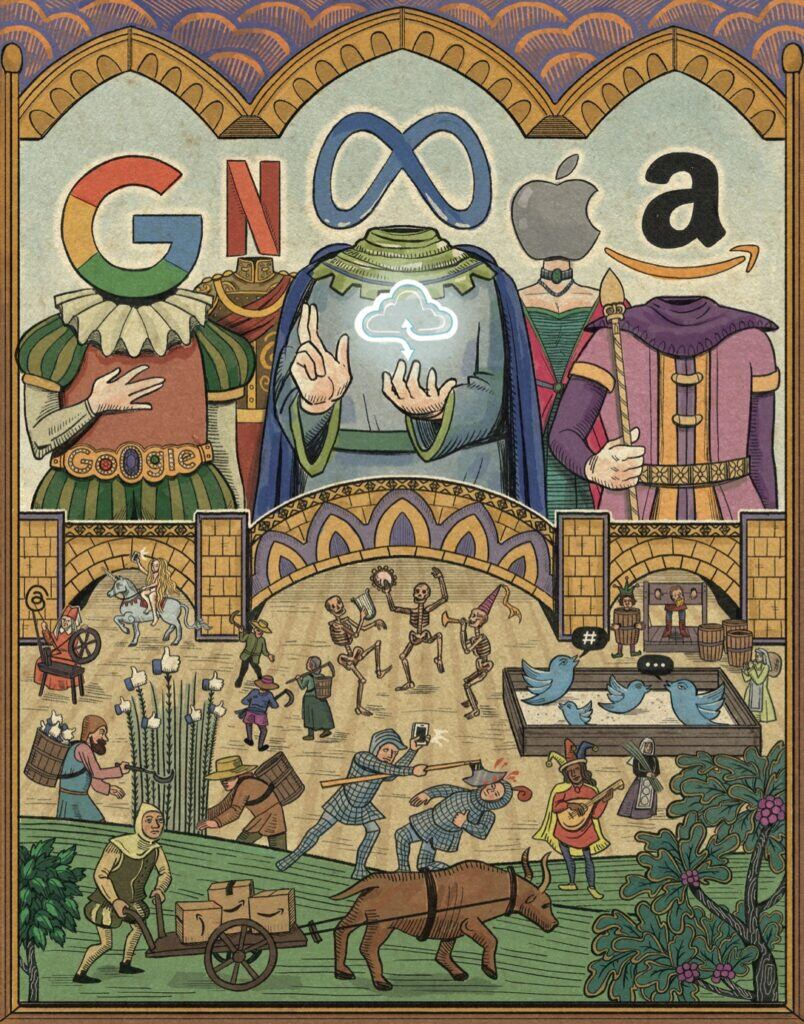
When we open an account on Instagram, we are - in a way - also allowed to use the digital “land” that is controlled by Meta for our own production and consumption, on the condition that we in turn provide Meta with the things it needs to control and reproduce that very digital world.
We are allowed to use Meta’s servers to connect with each other, and in return we give Meta our presence and our content (without which the platform wouldn’t exist) and our data (which they and their clients use to modify our behaviour to their benefit).
What makes this situation feudal is not so much that we provide the elites with the things they need to own and control the things that we need. This also happens under capitalism: what we produce per day is worth more than our daily wage, and the difference goes to our bosses, who use (part of) it to buy the machines we (need to) work with in order to earn a living.
Instead, what makes this situation feudal is the fact that it does not (directly) involve money and open markets. In contrast to workers in capitalist systems, we are not buying the products from our digital overlords in an open market with the money they pay us for our labour. Instead, we are allowed to use their digital lands, and - crucially - these lands turn out to be very hard to escape: just like our feudal ancestors, we are helplessly exploitable “sitting ducks”, unable to put our overlords under any serious form of competitive pressure.
This is why some people, like Yanis Varoufakis, are arguing that we are digital serfs. Or, put differently, why people like him are arguing that Big Tech is breaking capitalism:
“Ultimately, the cloudalist’s investment is aimed not at competing within a capitalist market but in getting us to exit capitalist markets altogether.”1
What about the race for AI?#
But if capitalism, as I wrote in the previous piece, is defined by the relentless competitive struggle for market share, which (among other things) forces capitalists to invest their surplus in technological innovation, aren’t we witnessing one of the most capitalist moments in history, with Big Tech companies pouring insane amounts of money into (quickly depreciating) means of production, to simply not lose out to the competition?
In other words: how can Mark Zuckerberg simultaneously be a feudal overlord and a cut-throat capitalist?
Here I believe it is important to remember that while market competition is specific to capitalism, competition in general is not: even feudal lords found themselves forced to keep up with military innovation in order to not be subdued by their competitors.
The question is: are we seeing “normal” capitalist competition over consumers, the way e.g. car makers invest in better engines to not fall behind the competition? Or are we witnessing a feudal arms race that will determine who gets to “sell us security”, the way feudal lords have always sold their serfs “security”.
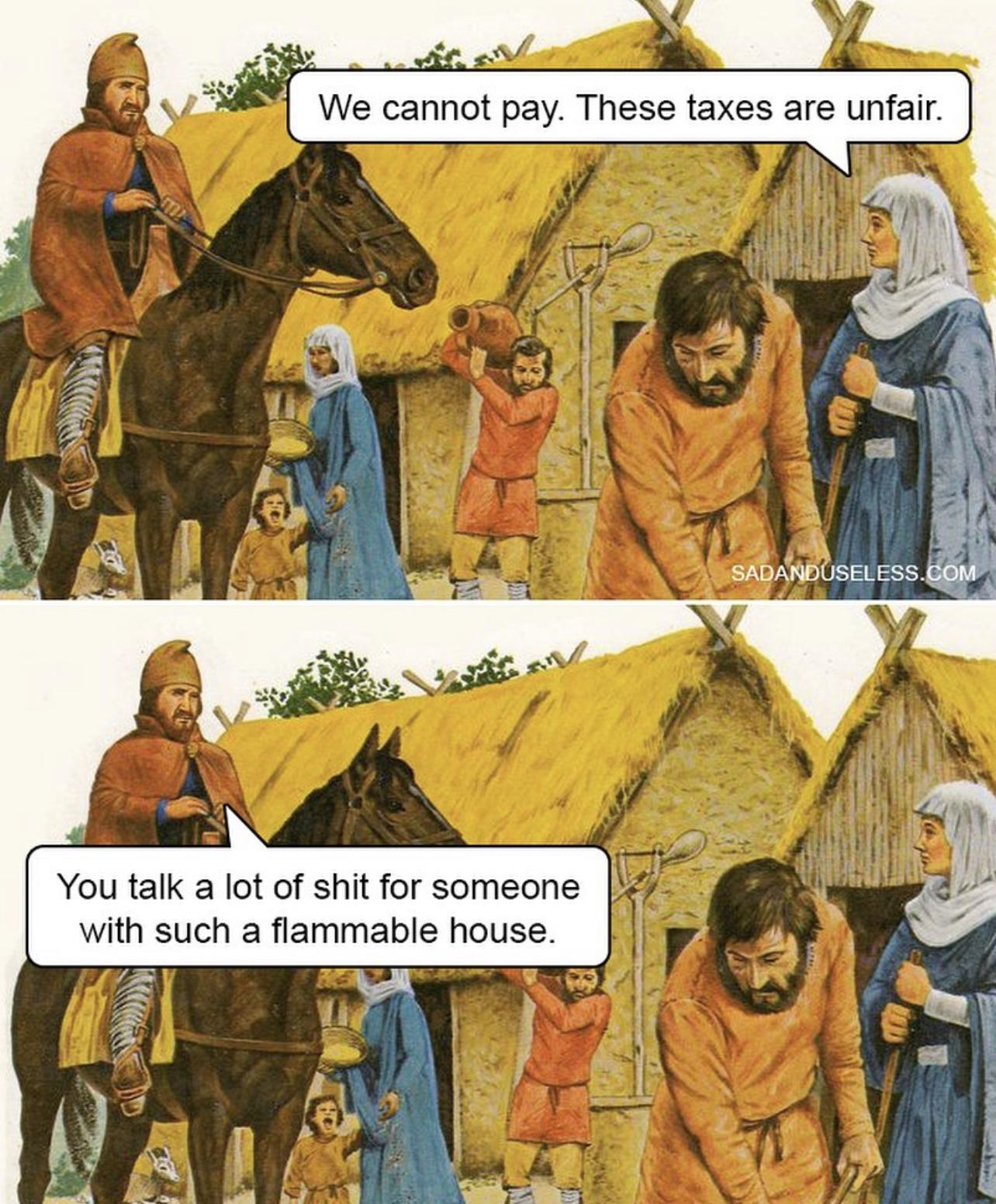
The answer to this question will ultimately depend on the extent to which AI elites will manage to get us hooked: it will depend on 1. how much we need their services for our day to day survival, and 2. on our ability to switch to alternatives when we feel we are getting a bad deal.
Technofeudal AI#
A lot has been said about these two questions. And a lot will be said. Maybe even by me. But for now, I want to leave it at this: if it turns out we need their AI to survive, and we have no open market to put them under any competitive pressure, we might be heading towards a future of technofeudal AI.
And if we allow ourselves some speculative dystopian sci-fi: while the reproduction of the power of the medieval feudal landlords depended quite directly on the value produced by their serfs, this might not similarly the case for the reproduction of the power of our future technofeudal AI lords. In other words, while medieval feudal landlords still had an incentive to at least keep their serfs alive, the same might not be true for our future technofeudal AI overlords?
Financial crisis or serfdom#
Finally, it should be pointed out that while people like me are still wondering if and how AI will be able to get us properly hooked, the capital market has already made it’s bet: as more and more experts are pointing out, the insane amount of money that has been poured into AI is very unlikely to be recuperated through normal market competition.
In other words, the only way for this amount of investment to make sense, is if we are heading towards a future of technofeudal AI, in which we are so dependent and stuck with our technofeudal overlords, that we are forced to hand over unprecedented amounts of wealth.
However bleak it might sound, this means that the best we can hope for at this point is financial collapse: that Cory Doctorow is right in predicting that AI will fail to create the lock-in and dependence the tech lords expect it to create, and that billions of dollars of investment will evaporate like the cooling water of the data centers they helped to build.
If not, we might find ourselves (again) on the wrong side of a new mode of production.
Footnotes#
-
p. 115 of 259 of Varoufakis, Y. (2023). Technofeudalism: What killed capitalism. Random House. ↩︎
Comments
You can use your Fediverse (i.e. Mastodon, among many others) account to reply to this post/account.