Some thoughts on feudalism and capitalism
Introduction#
In this post I put together some ideas on capitalism, what it is, what it is not, and why it makes sense to recognize that we’re in it.
The reason why I am writing this, is because I feel that the term “capitalism” is often thrown around without too much care. As something that has to do with markets and profits. Or as something that is simply “not socialism or communism”.
Regardless of one’s politics, I believe that it is good to understand how capitalism is a particular combination of interconnected features that together create a particular system, with particular consequences.
Disclaimer 1: this story has been written down many times by others. I just felt like writing it down in my own words.
Disclaimer 2: this story simplifies a highly complex history that could be told in many other ways.
Two sketches#
In defining what is not capitalism, people often compare it with socialism or communism. After all, that’s what millions of people have been fighting over throughout the twentieth century: it’s fresh in our collective memory.
But I believe that to understand what capitalism is, and what it is not, it makes more sense to first compare it with feudalism. Not only because that system actually existed for centuries, but also because it is the system capitalism emerged from.
Historically there have of course been many different kinds of feudalism: every corner of the world has/had its own idiosyncrasies. But since it was western Europe where the different pieces of capitalism truly “fell into place”, that’s where we start.
To explore how capitalism compares to feudalism, let’s make two rough sketches.
Sketch 1: feudalism#
Protection money#
I guess one reasonable reference point for what feudalism looked like could be Game of Thrones, but then without the dragons: several powerful families manage to accumulate a certain amount of power that they are able to project over a certain territory. As in, a family is able to violently overpower anyone who challenges it.
This brings a certain level of security to people in that area, of the kind “if I do what these people say I won’t get killed”.
Of course, the local lords would expect something in return for this security: they would let people live on (and from) the land, but they would expect them to for example hand over part of their harvests (e.g. to feed the army) or they would expect people to serve in the army for part of the year. By submitting to this feudal deal, the people would become so-called serfs.
This, you could say, is the feudal exchange: the landlords protected the serfs within their territory, and in exchange the people within that territory provided the landlord with the means to actually provide that protection, directly with their labour or with the product of their labour. Serfs who refused to pay were excluded from that protection. This “exclusion from protection” must have been quite similar to the way the maffia “excludes people from its protection”: along the lines of “that’s a nice shop you got there … would be a shame if something would happen to it”.1
Landlord shopping#
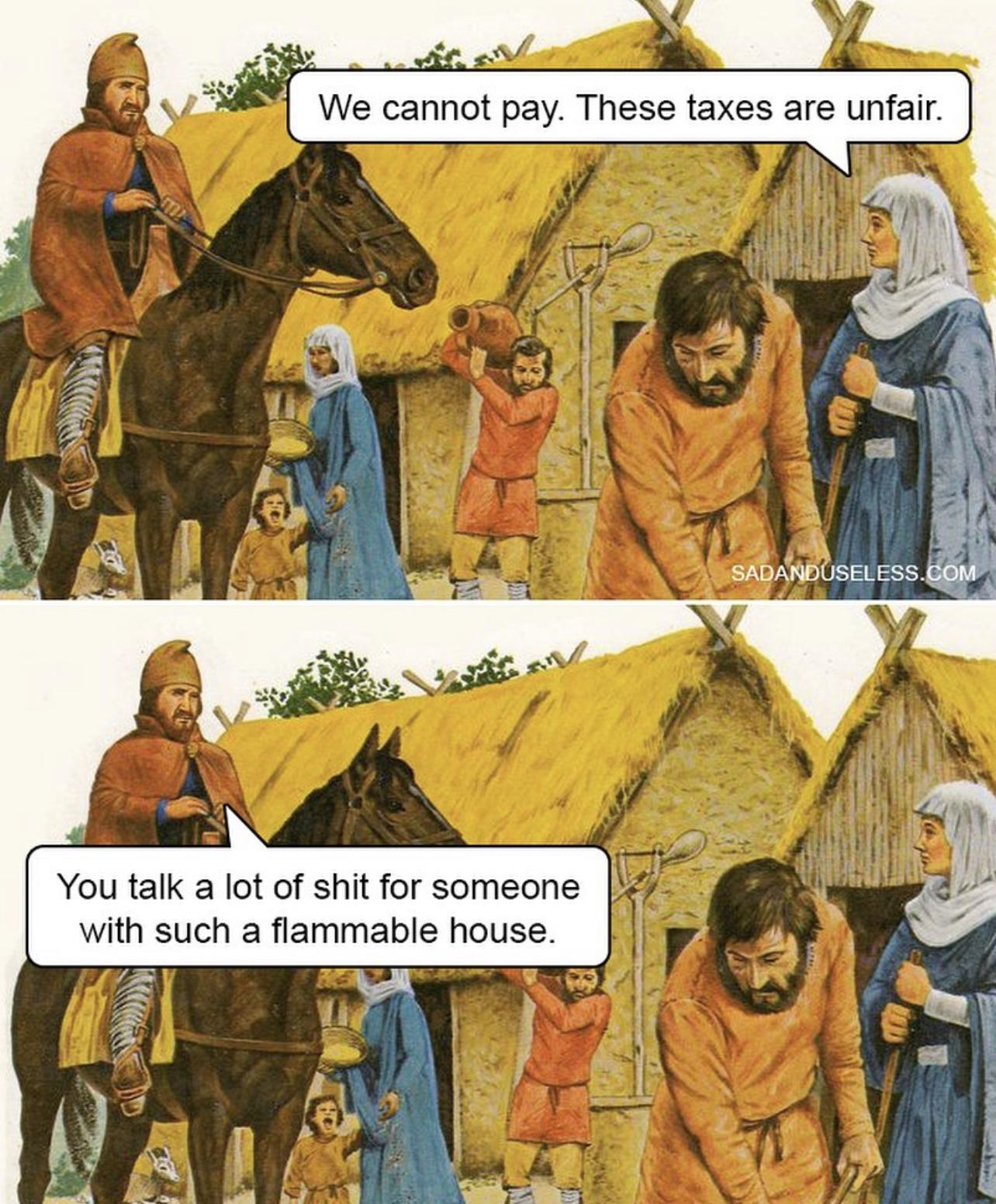
You might wonder: why didn’t serfs simply leave? There are many answers to this question, but it probably didn’t help that 1. the world outside the feudal territories was often quite dangerous, 2. that violent competition between landlords meant that the other landlords were “forced” to exploit their serfs just as much, and 3. that it was anyway hard for people to travel large distances.2 Effectively, serfs probably didn’t just “shop around” in search for the best feudal deal.
As a result, the “deals” available to serfs were often pretty rough, although the situation probably varied a lot in space and time, as this Wikipedia page suggests:
“… [t]he amount of labour required varied. In Poland, for example, it was commonly a few days per year per household in the 13th century, one day per week per household in the 14th century, four days per week per household in the 17th century, and six days per week per household in the 18th century.”
Feudal pursuit of power#
Some people say that “greed” is a defining feature of capitalism. But although capitalism might indeed be unique in how it celebrates greed as virtue, the desire for wealth, power, status has been with us for much longer than capitalism exists. Indeed, just like in Game of Thrones, (coalitions of) local landlords and their families were often at war with each other, in the pursuit of of this very wealth, power and status.
In a feudal system, the main way for elites to increase their power was to increase their territory and with that, the number of serfs that would work (part of the year) for them. You could for example force the additional serfs to provide you with more food so you can feed bigger armies, or you could force them to be part of this bigger army itself.
Of course, by expanding your realm you also had to defend a larger territory, but if you played your cards right, you could find yourself in charge of an increasing number of people and an increasing amount of land and produce.
Competition as war#
Some people would say that “competition” is a defining feature of capitalism. But although capitalism might be unique in how it celebrates competition as a virtue, people have been competing over power, wealth and status for much longer.
The way people competed in feudal systems, however, does differ substantially from the way people compete under capitalism, and this has profound implications for the spread of technological innovation.
In short, in feudal systems, the pursuit of power and wealth mainly manifested as constant war. As a landlord, you would spend most of your life fighting or preparing for war. This was not just the main tool of accumulating power and wealth, it was also - culturally - the main way of earning respect and status.
Feudal (lack of) innovation#
This never-ending military competition between feudal elites of course did lead to considerable military innovation: from new weapons and new fighting techniques to new ways of managing and deploying armies: those who did not adapt and adopt would soon feel the “evolutionary pressure” of war, and be overpowered by those who did.
But what this feudal competition did not push for as much, was innovation in the production of regular stuff that was not directly connected to war and violence: the everyday objects people use throughout the day and the food that they eat.
In fact, serfs could easily use the same farming techniques for decades, if not centuries, without ever facing any pressures or incentives to change.
To better understand why, it helps to consider the drivers behind innovation.
The question here is not only why someone would go out of their way to develop new, more efficient forms of production, but also whether there were any “evolutionary pressures” that selected the better techniques and “push out” others.
Feudal incentives#
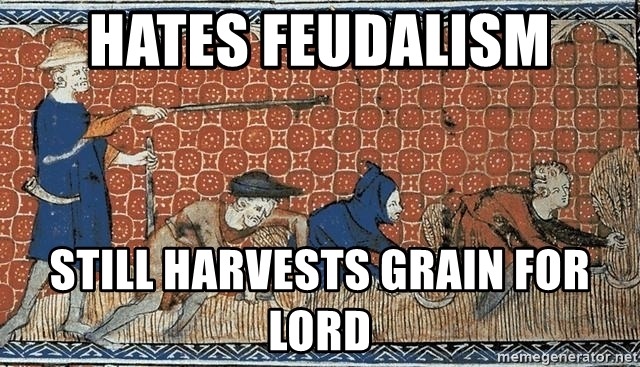
Let’s first consider the former: why would serfs go out of their way to develop new better forms of production? Here, it is important to recognize that landlords would often squeeze as much value out of the serfs on their territories as possible. After all, those who did not, would have weaker armies, and would over time lose the competition over territory.
In this context, if you, as a serf, would come up with a way of producing twice as many onions in the same amount of time, you would most likely end up with the same amount of onions for yourself: the landlord would simply find a way to violently squeeze the rest out of you as well.
As a result, in a feudal system, the people involved in production, who were the people most likely to improve production, had relatively little incentives to do so. Landlords would of course have benefited from having more food at their disposal, but to push for this they would have had to engage with farming and crafts and that was generally considered to be below the dignity of the elite. Farming and craftsmanship is for the common people: not for a lord. Landlords were too busy playing their “glorious” games of war and conquest.
Feudal evolutionary pressures#
What also played a role in the lack of technological innovation, was the lack of any serious market pressure. This was to a large extent because of two interconnected reasons.
First, serfs were often largely self-sufficient: they mostly lived from the produce that they were allowed to keep.
Secondly, the exchange between serfs and their landlord was mostly in kind, meaning that serfs were allowed to use the land, and received some form of protection, in exchange for which they handed over some of their harvests, and served in armies. None of these exchanges necessarily involved any money.
As we will see in the next sketch, it is this absence of money and markets that prevented feudal systems from producing the wealth and destruction of capitalism.
Sketch #2#
Separation of means of production and labour#
Let’s make a second sketch. This time we imagine the English countryside somewhere between the 15th and the 18th century. For centuries, serfs have been living the “feudal deal”: they have been allowed to live on the land controlled by their landlords on the condition that they hand over part of their produce. But somewhere in the 18th century, a new deal is starting to emerge.
Around this time, for reasons beyond the scope and purpose of this post, more and more elites find themselves forced to replace the feudal deal with something we now recognize as capitalism.
At the basis of this transition lies the separation of the means of production and labour: instead of allowing serfs to use the land for themselves in exchange for some of the produce, elites start to explicitly claim the land they control as theirs, and they start to expel former serfs as trespassers and intruders.
The literature talks about this transition as “enclosure”: elites “fencing off” the land as “theirs”, pushing people off the land that they worked for centuries.
The capitalist deal#
Of course that land still needed to be worked: crops do not grow themselves. But instead of allowing people to live on the land in exchange of some produce, elites - let’s call them capitalists - started to hire some of the expelled communities to work the land in exchange for a wage.
This, in a nutshell, is the capitalist offer: “I own all of this land - the means of production - but I do not have enough hands to work it. You former serfs, on the other hand, have plenty of hands but no land. Why don’t we make a deal? You can (again) come and work the land, but this time both the land and whatever you produce is fully mine. I will then sell the produce on the market, and use part of the proceeds to pay your wage.
Similarities between feudalism and capitalism#
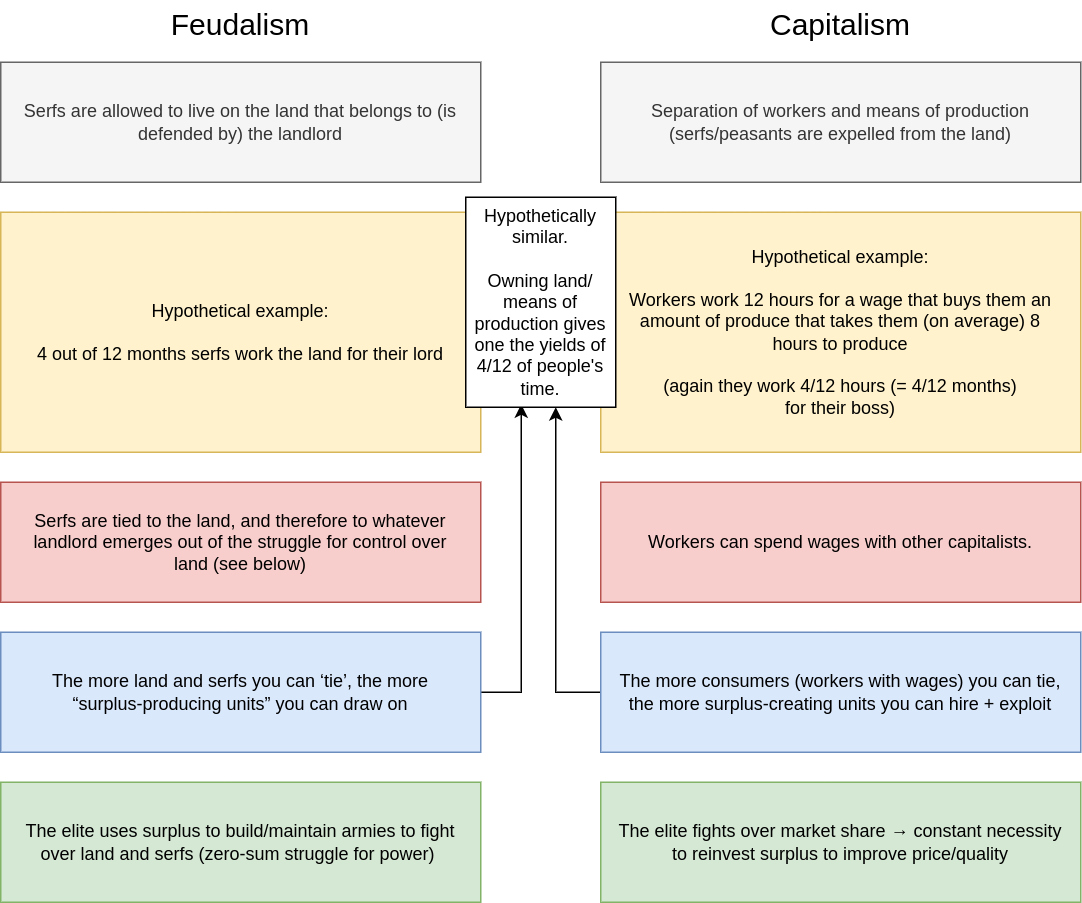
“Ok”, you might think, “how does this situation then fundamentally differ from feudalism?” Indeed, much like in feudal times, the workers work part of the day for themselves (i.e. the part of the daily produce that pays their daily wage) and part of the day for their boss (i.e. the “surplus”, or the part of the daily produce that is left for their boss).
You could even say that, much like feudal lords increased their power by extracting more and more surplus form more and more serfs, capitalists increase their power by extracting more and more surplus from more and more workers.
What makes this so different?
Money and open markets#
The answer lies in money and markets. To begin with, it is important to recognize that capitalism, much more than feudalism, depends on the exchange of money: workers are paid a wage in money by bosses who are selling their produce for money.
These two money flows largely connect of course: workers use their wage to buy the produce from capitalists.
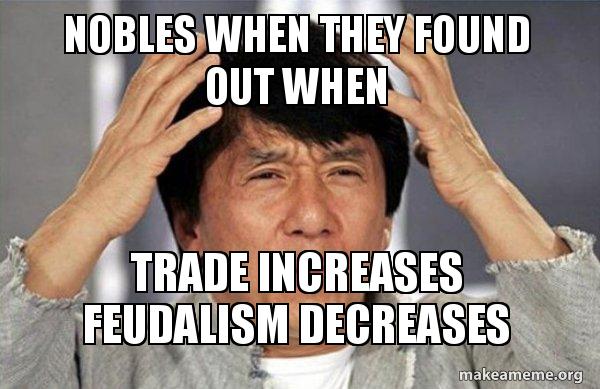
But - and this is a crucial difference with feudalism - workers are not obliged to only do business with their bosses: they might work for their bosses, but they can spend their wages anywhere on the open market. They can buy from their bosses of course, but they can just as well buy from the competition. And they will surely use this freedom to make sure they are getting the best quality for the lowest price.
nobles-when-they.jpg
Capitalist incentives#
This presents a new challenge to the elites: to keep their surplus-producing farms and factories running, or indeed to expand these in the pursuit of wealth and power, they need to retain (and increase) market share. And to retain market share, their produce needs to be cheap and high quality.
There are multiple ways for a capitalist to drive down costs. You could of course cut wages, externalize environmental destruction to society, or undermine the bargaining position of trading partners. See also this post.
But for now I want to focus on the other main way to reduce cost and increase quality: the reinvestment of surplus in the pursuit of technological innovation.
Here it should be noted that capitalists, in contrast to the feudal landlords of the past (and to the utter distaste of remaining aristocracy), tend to be more directly involved in production processes. And since both the means of production and fruits of these means of production are fully theirs, capitalists are the direct beneficiaries of any productivity growth. In contrast to feudalism, under capitalism the incentives favor innovation.
Evolutionary pressure#
Yet it is not just a matter of matching incentives. Since workers are scouring the market for bargains, any capitalist that fails to keep up with technological innovation will simply fail to meet the latest price-quality expectations and be pushed out of the market. Only the capitalists that adapt and adopt remain.
To capitalists, the incentives described above might be the attractive carrot of capitalism, but the market pressure is the unforgiving stick.
Put differently, one could argue that whereas under feudalism elites fight a zero-sum game over land and serfs, under capitalism, elites are forced to pursue productivity growth in their fight over market share.
Constant change#
Remember that under feudalism, serfs could easily use the same production techniques for centuries: they could not be “pushed out of the market” because 1. they mostly consumed their own produce, 2. there were no markets, and 3. there was barely any money going around.
Under capitalism, however, the different components link up to create a world of relentless technical change: those who do not change along are simply replaced by those who do.
Conclusion#
This is the basic idea I wanted to bring across. From this perspective, it is not so much greed or competition that defines capitalism. Competition over wealth and power is older than capitalism, and will probably outlive it.
Instead, what makes capitalism fundamentally different from feudalism, is the separation of labour from the means of production, the ensuing emergence of money relations and markets, and the resulting systematic pressure to reduce costs to retain market share.
A lot more can be said. A lot more has to be said. The goal of this post is not to reduce all the world’s complexities to a couple of simple drivers and incentives. Instead, the goal is to have some common analytical ground to stand on when we talk about capitalism, so that we are well prepared to connect it with all the other stories that need to be told.
-
To just spell it out explicitly: rather than “not providing protection in the case of violence” the landlords/maffia were/are often actively part in that very violence. ↩︎
-
Landlords had a collective interest in keeping the outside world dangerous of course: to finance the occasional raid to burn any surrounding free settlements to the ground. Having said that, as Jason Hickel describes in the first chapter of his book “Less is more”, we may have long underestimated the historic successes of self-organized communities of “free people” in what were long believed to be dark, oppressive feudal times. ↩︎
Comments
You can use your Fediverse (i.e. Mastodon, among many others) account to reply to this post/account.